
Learn Chinese with real content.
Guides, methods and resources for learning Chinese through videos.
Latest articles

Chinese Listening Practice with Transcripts: 5 Short Dialogues for Beginners
Five short Mandarin dialogues with server-generated audio, transcripts, vocabulary, questions, and answers.Read article →
How to Learn Chinese with YouTube: A 15-Minute Study Routine
A focused 15-minute routine: choose a passage, prepare four expressions, watch, check, and recall.Read article →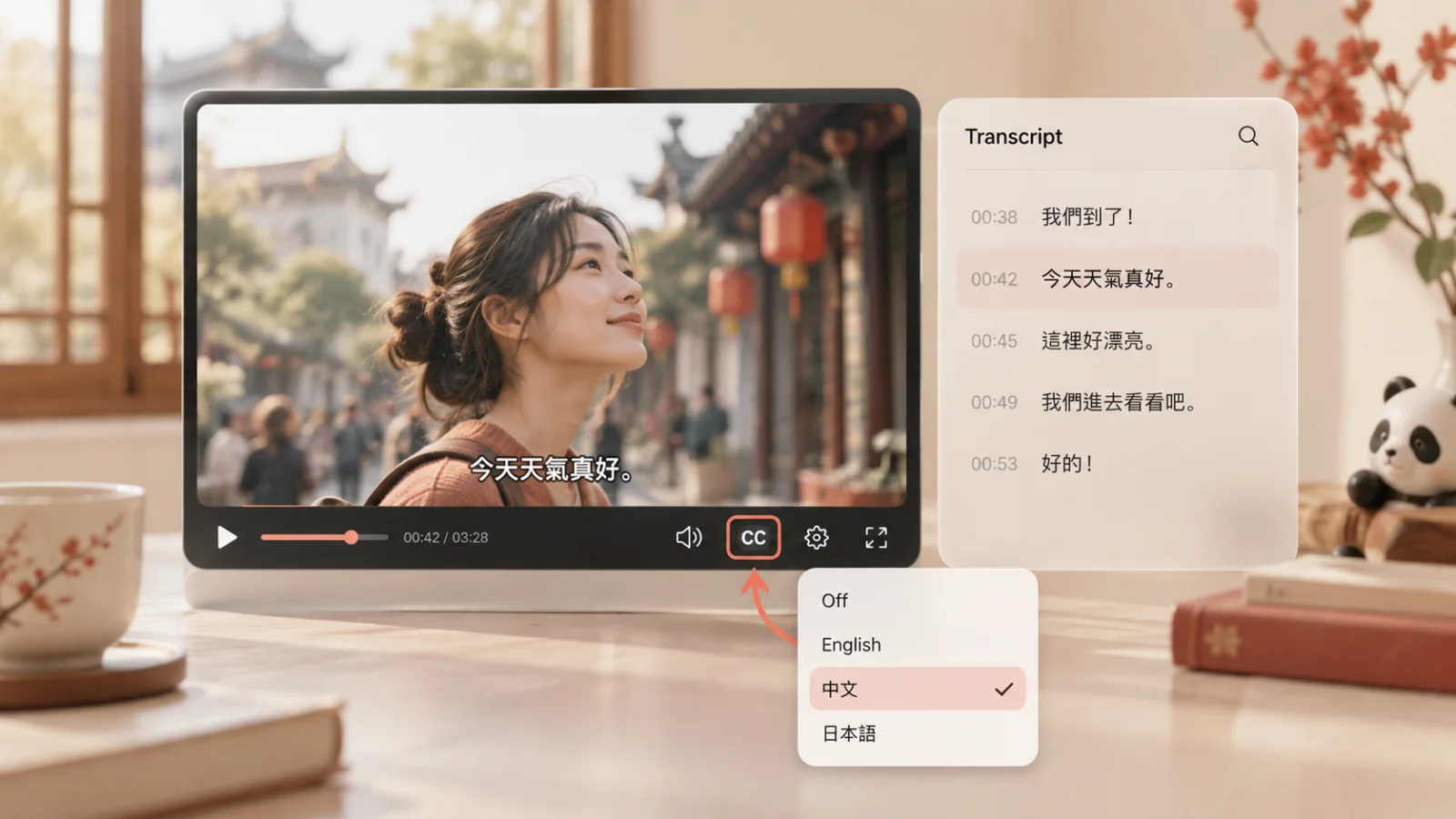
Chinese Subtitles on YouTube: How to Find Them and Use Them for Learning
Find Chinese captions, open the transcript, distinguish translated and burned-in text, and check whether a video is useful for Mandarin practice.Read article →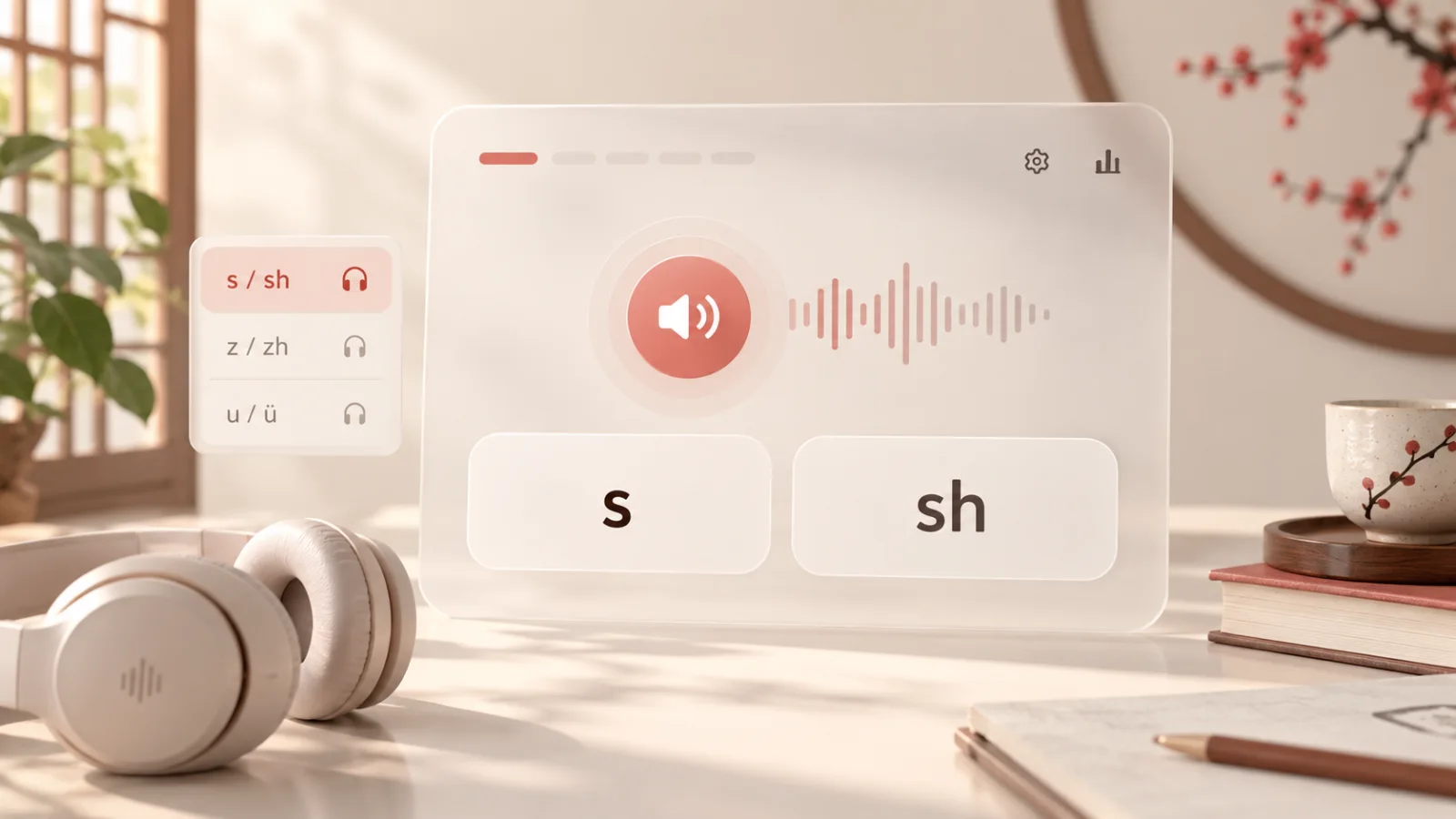
Pinyin Listening Practice: 10 Audio Exercises for Confusing Mandarin Sounds
Hear ten short human recordings and practice distinguishing s/sh, z/zh, c/ch, aspiration, and u/ü.Read article →
Chinese Vocabulary Flashcards: How to Build a Small Deck from One Video
Build five focused Chinese vocabulary cards from one short video exchange without saving every unfamiliar word.Read article →
Chinese or English Subtitles? Which Should You Use to Learn Mandarin?
Choose Chinese, English, dual, or no subtitles for the problem you have in your next Mandarin study session.Read article →
Chinese Comprehensible Input: How to Choose Videos at the Right Level
Use a short difficulty check, compare three examples, and choose Chinese videos you can actually follow today.Read article →
Chinese YouTube Channels for Intermediate Learners: What to Watch Next
Move beyond beginner videos with five Chinese channels, specific starting points, text-support notes, and a clear next listening task.Read article →
Why You Can Read Chinese but Can’t Understand Spoken Mandarin
Use one short recording to separate unfamiliar language, missed spoken forms, and sentence-processing difficulty.Read article →
Chinese Vlog Vocabulary: Words for Travel, Food, and Study Vlogs
Useful Mandarin words for travel, food, and study vlogs, plus filler words, reactions, and a practical study routine.Read article →
Chinese Listening Practice Online: A Three-Pass Video Method
Turn one short Chinese video into a focused listening session with a practical three-pass routine.Read article →
Chinese Shopping Phrases: Ask About Size, Price, and Returns
Follow both sides of a shop conversation, from finding the right size to checking whether an exchange is possible.Read article →
Chinese Restaurant Phrases: Follow the Order and Ask for Changes
Order a dish, check a change, and recognize the reply instead of learning only your half of the conversation.Read article →
Chinese Flirting Phrases: Compliments, Invitations, and the Reply
Distinguish a friendly compliment, a clear invitation, and a dramatic confession before copying a line from a show.Read article →
Chinese Business Phrases: Confirm Decisions in a Meeting
Keep a proposed date separate from a confirmed deadline, and leave a meeting knowing who will do what.Read article →
Chinese Greeting Phrases: Choose a Greeting and Follow the Reply
Know when a line opens a conversation, asks a real question, or simply acknowledges someone you already know.Read article →
Chinese Family Vocabulary: Keep Track of Who Is Related to Whom
Learn the family words that change a relationship, then use a tiny family tree to check a spoken introduction.Read article →
Business Chinese Vocabulary for Following an Order
Learn business Chinese vocabulary for quotes, orders, quantities, invoices, and delivery, then use an original order-tracking exercise.Read article →
Chinese Measure Words: Count the Item You Actually Mean
Learn Chinese measure words with practical noun pairs, container contrasts, original examples, and exercises that check what is being counted.Read article →
Chinese Word Order: Build the Sentence Around Its Action
Understand Chinese word order with original sentence-building exercises for subjects, time, place, questions, and important exceptions.Read article →
Chinese New Year Vocabulary for a Family Video
Learn Chinese New Year vocabulary with pinyin, useful verb pairs, a family-visit dialogue, and a focused listening task.Read article →
Chinese Compliments for Skills, Effort, and Good Work
Give specific Chinese compliments about skills and work, understand common replies, and practice an original exchange with pinyin.Read article →
How to Apologize in Chinese and Say What Happens Next
Learn to apologize in Chinese with 对不起, 不好意思, and 抱歉, then practice explaining a mistake, offering a repair, and following the reply.Read article →
Chinese Directional Complements: Follow the Movement
Learn Chinese directional complements with room-based examples, 来 and 去 contrasts, object movement, and annotated listening exercises.Read article →
Chinese Question Words: Ask for the Missing Information
Use Chinese question words in the right sentence position, distinguish time and quantity questions, and practice matching questions to answers.Read article →
Chinese Reduplication: What Repeating a Word Changes
Understand Chinese reduplication with verb, adjective, and everyday time examples, plus original exercises that distinguish their functions.Read article →
Chinese Time Words: Reconstruct What Happened First
Use Chinese time words to follow before, after, then, and later. Practice an original timeline exercise and distinguish plans from past events.Read article →
Chinese Tone Sandhi: Hear the Tone Changes in Phrases
Understand Chinese tone sandhi for third-tone pairs, 不, and 一, with careful pronunciation notes, source audio, and a phrase-based practice plan.Read article →
Chinese Homophones: Use Context Without Ignoring Tones
Understand Chinese homophones with original context exercises, clear tone distinctions, and a method for checking an uncertain word in a video.Read article →
Chinese Gaming Slang: Follow the Chat Around a Match
Learn Chinese gaming slang and practical chat vocabulary for teaming up, connection trouble, reactions, and understanding who does what next.Read article →
Chinese Internet Slang: Decode the Comment Before Copying It
Decode Chinese internet slang through number codes, pinyin initials, and changed meanings, with examples and a context-checking exercise.Read article →
Choose a Chinese Vocabulary App Around Your Next Study Task
Choose a Chinese vocabulary app for dictionary lookup, structured lessons, reading, or preparing a real video, with a practical comparison task.Read article →
Chinese Vocabulary Test: 20 Questions About Meaning in Context
Take an original Chinese vocabulary test with 20 context questions, hidden answers, explanations, and a focused review plan.Read article →
Chinese Small Talk: Keep the Conversation Going After Hello
Practice Chinese small talk with follow-up questions, shared details, short replies, and an original conversation that continues after the greeting.Read article →
Chinese Phone Conversations: Identify, Clarify, and Call Back
Practice Chinese phone conversations with pinyin, clear repair questions, callback arrangements, and an original message-taking exercise.Read article →
Chinese Hotel Phrases: Confirm the Room and the Reply
Use Chinese hotel phrases for reservations, room details, breakfast, and simple requests, with an original check-in exercise and pinyin.Read article →
Chinese Doctor Phrases: Describe What You Feel Clearly
Learn Chinese doctor phrases for describing discomfort, onset, and uncertainty, with pinyin and an original communication exercise.Read article →
Chinese Airport Phrases: Follow a Gate Change and Boarding Update
Learn Chinese airport phrases for gates, boarding, delays, and clarification, with an original update exercise that keeps the final details clear.Read article →
Order Coffee in Chinese: Answer the Choice the Barista Asked
Learn to order coffee in Chinese with pinyin, size and temperature choices, milk requests, takeaway replies, and an original practice dialogue.Read article →
Chinese Job Interview Questions: Answer the Question You Heard
Practice Chinese job interview questions with pinyin, concise original answers, follow-up repairs, and a question-to-evidence rehearsal method.Read article →
Chinese Cooking Vocabulary: Follow the Actions in a Recipe Video
Learn Chinese cooking vocabulary for ingredients, preparation, and heat methods, then reconstruct an original recipe-language sequence.Read article →
Chinese Weather Conversations: Now, Forecast, and Changed Plans
Practice Chinese weather conversations with pinyin, present-versus-forecast contrasts, conditional plans, and a short original dialogue.Read article →
Chinese Emotion Words: Say What Someone Actually Expressed
Learn Chinese emotion words with pinyin, useful sentence patterns, and exercises that separate feelings, appearances, and worries about events.Read article →
Chinese Clothing Vocabulary: Describe and Identify an Outfit
Learn Chinese clothing vocabulary with pinyin, color and garment phrases, 穿 and 戴 examples, and an original outfit-identification exercise.Read article →
Chinese Sports Vocabulary: Follow the Activity and the Result
Learn Chinese sports vocabulary for activities, practice, matches, winning, and losing, with pinyin and an original result-tracking exercise.Read article →
Chinese Technology Vocabulary for Following a Simple Task
Learn Chinese technology vocabulary for files, downloads, uploads, installation, and updates, with an original task-status exercise.Read article →
Chinese Idioms in Conversation: Learn What the Phrase Does
Learn Chinese idioms in conversation through three usable expressions, plain-language paraphrases, original scenes, and a context-based review task.Read article →
Polite Requests in Chinese: Ask for Help and Follow the Reply
Make polite requests in Chinese with clear actions, permission questions, and original dialogues that distinguish acceptance, delay, and refusal.Read article →
Chinese Invitation Phrases: Invite a Group and Read the Reply
Use Chinese invitation phrases for a casual group event, with pinyin, clear replies, practical follow-ups, and an original guest-list exercise.Read article →
Chinese Scheduling Phrases: Turn Availability into a Clear Plan
Use Chinese scheduling phrases to compare availability, choose a meeting time, change a plan, and confirm a precise place in an original exercise.Read article →
Chinese Payment Phrases: Ask the Method and Confirm the Status
Learn Chinese payment phrases for available methods, totals, change, and payment status, with pinyin and an original checkout exchange.Read article →
Le vs. Guo in Chinese: A Particular Event or an Experience?
Compare le and guo in Chinese with original event-versus-experience scenes, negative forms, sentence-final le, and exercises with explanations.Read article →
The Three De Particles in Chinese: 的, 地, and 得
Distinguish the three de particles in Chinese with original noun, manner, and complement examples, sentence repairs, and a written practice set.Read article →
The Chinese Ba Construction: Say What Happens to the Object
Learn the Chinese ba construction through object, action, and result examples, with original instructions, negation contrasts, and repair exercises.Read article →
The Chinese Bei Construction: Track What Happened to the Subject
Understand the Chinese bei construction with original active/passive pairs, known and omitted agents, negative sentences, and role-tracking exercises.Read article →
Chinese Result Complements: Hear What the Action Achieved
Learn Chinese result complements through original action-versus-outcome examples, negative results, potential contrasts, and a short practice set.Read article →
Chinese Potential Complements: Can the Result Be Reached?
Understand Chinese potential complements with 听得懂, 看不清, and 做不完, then compare capability with an actual result in original exercises.Read article →
Chinese Bi Comparisons: Compare Qualities Without Reversing the Meaning
Build Chinese bi comparisons with original examples, amounts of difference, equality, negative comparisons, and a worked decision exercise.Read article →
Chinese Topic-Comment Sentences: Find What the Speaker Is Talking About
Read Chinese topic-comment sentences with original fronted-object, part-whole, and contrast examples, plus exercises that separate topic from actor.Read article →
Chinese Rhetorical Questions: Hear the View Behind the Question
Interpret Chinese rhetorical questions with 难道, 不是…吗, 怎么会, and 谁不, using context, speaker stance, and original response exercises.Read article →
Chinese Conditional Sentences: If, As Long As, and Only If
Understand Chinese conditional sentences with 如果, 要是, 只要, 只有, and 除非 through original scenarios, logic checks, and listening exercises.Read article →
Suiran Danshi in Chinese: Follow the Contrast After Although
Use 虽然…但是 in Chinese with original concession examples, shared and different subjects, natural English translations, and contrast exercises.Read article →
Yaobu and Yaoburan: Otherwise or a Suggestion in Chinese?
Compare 要不 and 要不然 in Chinese with original otherwise and suggestion examples, context checks, and a clear distinction from 要不要 questions.Read article →
Yue Lai Yue and Yue…Yue: Two Chinese Patterns for Change
Distinguish 越来越 from 越…越 with original examples, changing degrees, linked scales, negative patterns, and listening exercises.Read article →
Cai vs Jiu in Chinese: Hear the Expectation Behind Time and Amount
Compare 才 and 就 with original time, age, price, and conditional examples. Separate the stated fact from the speaker’s expectation.Read article →
Hai vs Zai in Chinese: Still, More, and One More Time
Distinguish 还 from 再 with original continuity, quantity, repetition, and modal examples. Learn why 我还想再看一遍 can use both.Read article →
You vs Zai: Two Ways to Say Again in Chinese
Choose 又 or 再 for Chinese repetition with original reports, requests, negative commands, and future-recurrence examples beyond a past/future shortcut.Read article →
Yijing in Chinese: Already, Reached States, and Not Yet
Use 已经 with completed actions, reached states, ages, and durations. Compare already with 还没 through original examples and timeline exercises.Read article →
Chinese Serial Verb Constructions: Follow Two Actions as One Plan
Understand Chinese serial verb constructions through original movement-purpose, means-action, and linked-action examples with clear subject tracking.Read article →
Chinese Separable Verbs: Recognize the Action When Its Parts Split
Understand Chinese separable verbs such as 见面, 洗澡, and 帮忙 with original examples, inserted aspect and quantity, and natural participant phrases.Read article →
Spoken vs Written Chinese: Choose Language That Fits the Situation
Compare spoken and written Chinese through original message, announcement, conversation, and narration examples. Learn register without treating media as rules.Read article →
Erhua Pronunciation: Recognize Mandarin’s R-Colored Endings
Understand erhua pronunciation with 哪儿, 一点儿, and other common examples. Separate suffix r from syllabic 儿 and practice listening without overgeneralizing.Read article →
Chinese Neutral Tone: Hear Light Syllables Without Losing Them
Recognize the Chinese neutral tone in words and particles with clear pinyin examples, rhythm practice, and distinctions from full tones and tone sandhi.Read article →
Learn Chinese with Dramas: Turn One Scene into a Useful Conversation
Learn Chinese with dramas through a scene-selection rubric, character-role notes, subtitle checks, a worked fictional scene, and a sustainable review plan.Read article →
Chinese Cartoons for Learning: Pick Animation You Can Actually Follow
Choose Chinese cartoons for learning with verified source examples, a difficulty rubric, caption checks, and an adult-friendly scene-study approach.Read article →
Chinese Documentaries for Learning: Follow the Narration, Not Just the Pictures
Choose Chinese documentaries for learning with verified examples, narration/interview distinctions, a vocabulary map, and a worked process-listening task.Read article →
Chinese Podcasts with Transcripts: Compare the Text Support Before You Choose
Choose Chinese podcasts with transcripts using verified provider examples, an access checklist, and a practical method for turning text support into listening.Read article →
Chinese Short Stories with Audio: Follow the Plot Before Mining Words
Choose Chinese short stories with audio, compare verified reading sources, and practice character tracking, sequence, and retelling with an original mini-story.Read article →
A Language Reactor Alternative for Chinese: Choose by Your Study Workflow
Compare Language Reactor and a preparation-first Chinese video workflow. Check subtitles, review, devices, and current features before choosing an alternative.Read article →
Intensive vs Extensive Listening in Chinese: Choose the Mode Your Gap Needs
Compare intensive and extensive Chinese listening with concrete examples, a decision table, flexible weekly plans, and progress checks without a fixed ratio.Read article →
Chinese Dictation Practice: Diagnose What You Hear Before You Check the Text
Practice Chinese dictation with a step-by-step worksheet, pinyin and character options, error categories, and an original worked correction example.Read article →
Chinese Sentence Mining: Keep the Line You Can Reuse
Choose useful Mandarin sentences from video without copying an entire transcript into your review list.Read article →
Mandarin Filler Words: Follow the Thought Through the Pauses
Practice deciding whether a repeated expression carries the message, buys time, or connects the next idea.Read article →
Chinese Reaction Phrases: Hear More Than Yes or No
Sort short Mandarin responses by what they do: acknowledge, react, accept, or ask for confirmation.Read article →
How to Improve Chinese Listening and Speaking Together
Turn one understood video exchange into a response you can retrieve and adapt to your own situation.Read article →
Intermediate Chinese Listening Plateau: Find the Actual Bottleneck
Separate topic knowledge, sound recognition, and attention before changing your whole Mandarin study routine.Read article →
Chinese News Listening: Separate the Story from the Terminology
Use a short news report to track the event, source, and timing without turning every proper noun into vocabulary homework.Read article →
Chinese Interview Listening: Keep the Question and Answer Connected
Follow an interview answer by tracking the question, the first direct reply, and the examples that follow.Read article →
Chinese Numbers Listening: Keep the Value Attached to Its Unit
Practice quantities, prices, and times as complete pieces of information instead of isolated strings of digits.Read article →
Pinyin Subtitles for Chinese: Use Them to Check, Then Listen
Choose when pinyin is useful, separate sound checks from reading, and plan a small step away from constant text.Read article →
Chinese Grammar in Videos: Follow What the Pattern Changes
Learn one Mandarin pattern through its role in a scene, a contrast, and a small change to the original example.Read article →
Chinese Shadowing Practice: Understand Before You Copy
Choose a short, understood Mandarin line and compare one detail of timing or pronunciation at a time.Read article →
Mandarin Accents and Chinese Dialects: Check What You Are Hearing
Distinguish unfamiliar Mandarin delivery from a different Chinese variety before interpreting a difficult clip as failure.Read article →
A Weekly Chinese Review That Leaves Time to Watch Again
Review a few scenes, check what remains available, and remove expressions that no longer deserve your study time.Read article →
Chinese Directions Listening: Draw the Route, Then Check the Words
Turn Mandarin directions into a map so you can see whether the turn, landmark, and destination stayed connected.Read article →
Chinese Negation and Corrections: Keep the Final Meaning
Track what a speaker rejects, what replaces it, and which details remain unchanged when a plan is corrected.Read article →
Chinese Opinions and Agreement: Keep the Qualification
Hear what a speaker accepts, what they qualify, and whether a short response actually endorses the opinion.Read article →
Chinese Pronoun Reference: Track Who Did What in a Video
Build a small person-and-object map to resolve short references and avoid combining actions from different people.Read article →