
Start with the item in front of you
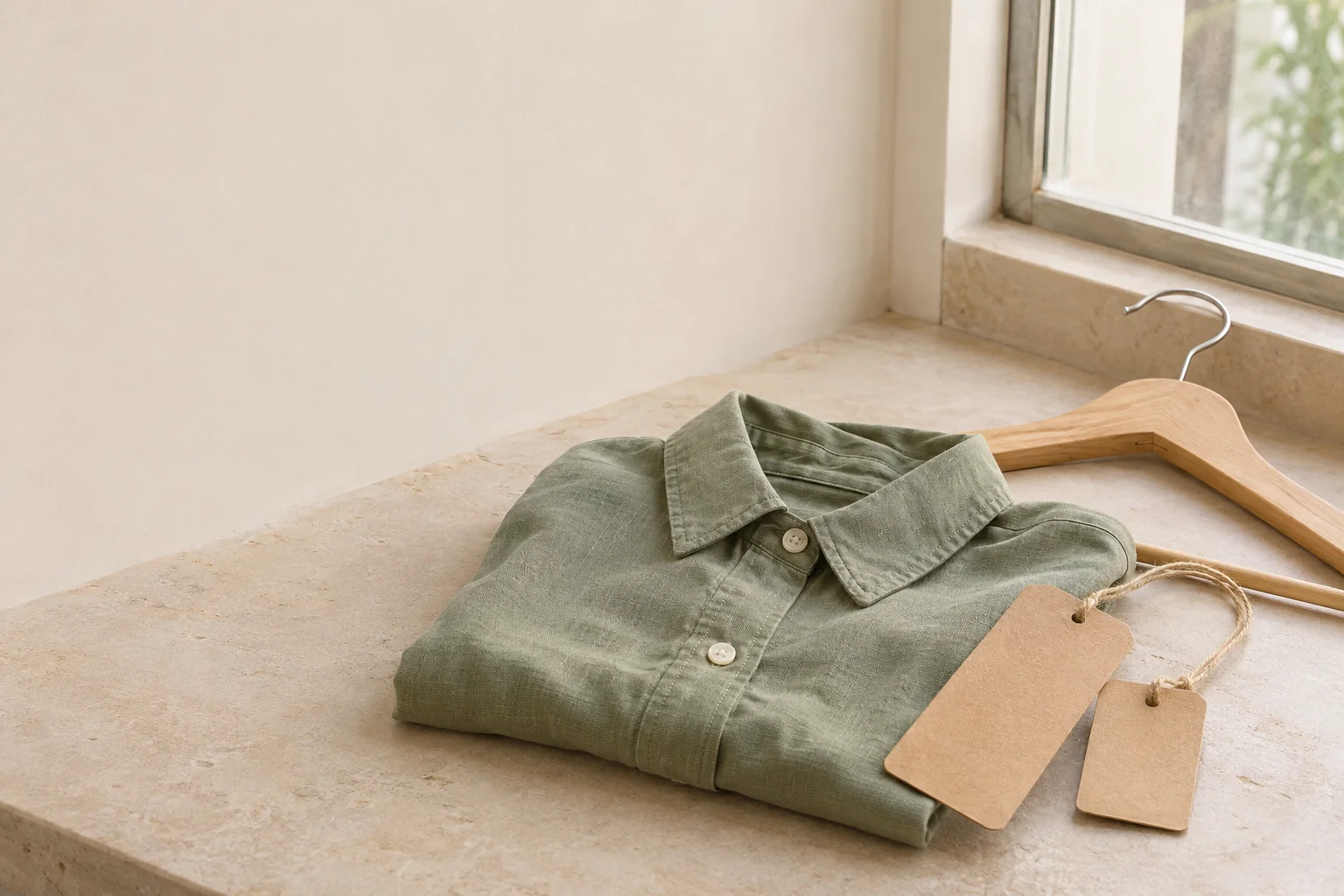
Imagine you have picked up a blue shirt. You do not need to describe the entire store or remember the Chinese names of every fabric. Pointing to the shirt and asking about its size gives the conversation a clear subject. That makes the reply easier to predict, although you still have to listen for whether the shop has what you need.
| Your request | Pinyin | Meaning |
|---|---|---|
| 这件有大一点的吗? | Zhè jiàn yǒu dà yìdiǎn de ma? | Do you have this in a slightly larger size? |
| 有别的颜色吗? | Yǒu bié de yánsè ma? | Do you have other colors? |
| 我可以试一下吗? | Wǒ kěyǐ shì yíxià ma? | Can I try it on? |
| 这件多少钱? | Zhè jiàn duōshao qián? | How much is this one? |
| 我再看看。 | Wǒ zài kànkan. | I will look around a little more. |
Here 件, jiàn, is the measure word attached to the shirt. Learn 这件 as a small usable unit rather than stopping this conversation to memorize a long classifier chart. If you are holding a different type of item, the wording may change. Your immediate goal is to understand this one situation accurately.
Notice that “Can I try it?” and “Do you have a larger one?” are different requests. A learner who memorizes only the first may get access to a fitting room without solving the size problem. Decide which piece of information you need before you speak. It gives you a reason to listen to the next sentence.
The replies that keep the exchange moving
Many phrase lists train the customer and leave the assistant silent. Reverse that for a moment. Read each answer below and say what you would do next. You do not need a polished Chinese response yet. You need to know whether to try the shirt, choose another color, or stop looking for a size that is unavailable.
| What you might hear | Pinyin | What it changes |
|---|---|---|
| 只有小号了。 | Zhǐ yǒu xiǎohào le. | Only the small size is left. |
| 大号没有了。 | Dàhào méiyǒu le. | The large size is no longer available. |
| 这件可以试。 | Zhè jiàn kěyǐ shì. | You can try this one on. |
| 试衣间在那边。 | Shìyījiān zài nàbiān. | The fitting room is over there. |
| 这是最后一件。 | Zhè shì zuìhòu yí jiàn. | This is the last one. |
The important contrast in the first two answers is availability, not the word “size” itself. Hearing 大号 is not enough to conclude that a large is available. Listen through to 没有了. In a video, pause after the entire reply and state the result in English before looking at the translation.
For more practice with this kind of connected speech, use the Chinese vlog vocabulary guide. A shopping vlog can contain greetings, travel and personal commentary too. Work on the shop exchange first instead of trying to learn everything the creator says.
A fitting-room conversation you can change
This is an original practice dialogue, not a quotation from a shop or a video. Read the Chinese first if you can, then use the pinyin to check pronunciation. For a listening exercise, find a separate recording with audible speech rather than treating written pinyin as audio practice.
| Speaker | Chinese and pinyin | Meaning |
|---|---|---|
| Customer | 这件有大一点的吗? Zhè jiàn yǒu dà yìdiǎn de ma? | Do you have this in a slightly larger size? |
| Assistant | 蓝色的没有了,白色的有。 Lánsè de méiyǒu le, báisè de yǒu. | The blue one is unavailable; we have the white one. |
| Customer | 白色的可以试一下吗? Báisè de kěyǐ shì yíxià ma? | Can I try the white one on? |
| Assistant | 可以,试衣间在那边。 Kěyǐ, shìyījiān zài nàbiān. | Yes, the fitting room is over there. |
| Customer | 谢谢。我先试一下。 Xièxie. Wǒ xiān shì yíxià. | Thanks. I will try it on first. |
Now change only the color. Suppose the blue shirt is available and the white one is sold out. Can you change the assistant’s reply without rewriting the whole dialogue? Next, keep the color but change the size. This small substitution exposes whether you understand the sentence or have simply memorized its English translation.
Price: repeat the amount before making a decision
Use 是一百八十块吗? Shì yìbǎi bāshí kuài ma? to check “Is it 180 yuan?” This is a practice amount, not a typical shirt price. Repeating a number gives the other person a chance to correct your interpretation. If you caught only part of it, 请再说一遍, qǐng zài shuō yí biàn, asks them to say it again.
You may see a price written down and still want to hear how it is said. Compare what the assistant says with the displayed amount, then replay without looking. Avoid practicing only round numbers. An amount such as 168 forces you to retain more of the spoken sequence than 100 does.
Ask about an exchange before assuming it is allowed
退, tuì, is associated with returning something; 换, huàn, with exchanging or changing it. They are useful words to distinguish when a shirt does not fit. They do not establish a store’s policy. Conditions can differ, so ask about your specific item and keep the answer together with any written policy or receipt.
- 可以换吗? Kěyǐ huàn ma? Can it be exchanged?
- 可以退吗? Kěyǐ tuì ma? Can it be returned?
- 需要小票吗? Xūyào xiǎopiào ma? Do I need the receipt?
- 几天内可以换? Jǐ tiān nèi kěyǐ huàn? Within how many days can it be exchanged?
Do not reduce a long answer to the first 可以 you hear. The assistant might allow an exchange only under a condition you missed. If you cannot follow the explanation, ask them to show the relevant written information. This is also a useful listening task for a shopping clip: identify the permission and then identify its condition.
Turn one shopping clip into a short study session
Choose a shop scene with clear audio and a small number of speakers. If selecting a clip is the hard part, start from the Chinese learning guides and use their difficulty checks. An edited haul video in which someone lists purchases is a different task from an actual conversation at a counter.
Before watching, prepare a few expressions central to the exchange: the item, its size, an availability phrase and the price. Watch once to identify what the customer wants. On the next pass, focus on what changes after the assistant replies. Write one plain sentence: “The larger blue shirt is unavailable, so the customer tries the white one.”
In LearnThenWatch, prepare unfamiliar expressions from your chosen supported video, then watch and review the useful ones afterward. Keep the review selection tied to this shopping task. The sentence-mining guide explains how to keep enough surrounding context when a single word would lose the point.
Finish by changing one detail and saying your own request aloud. Ask for a different size, then imagine the item is sold out. Your next useful phrase is the one that lets you handle that answer, not the twentieth name of a fabric you are unlikely to buy.