
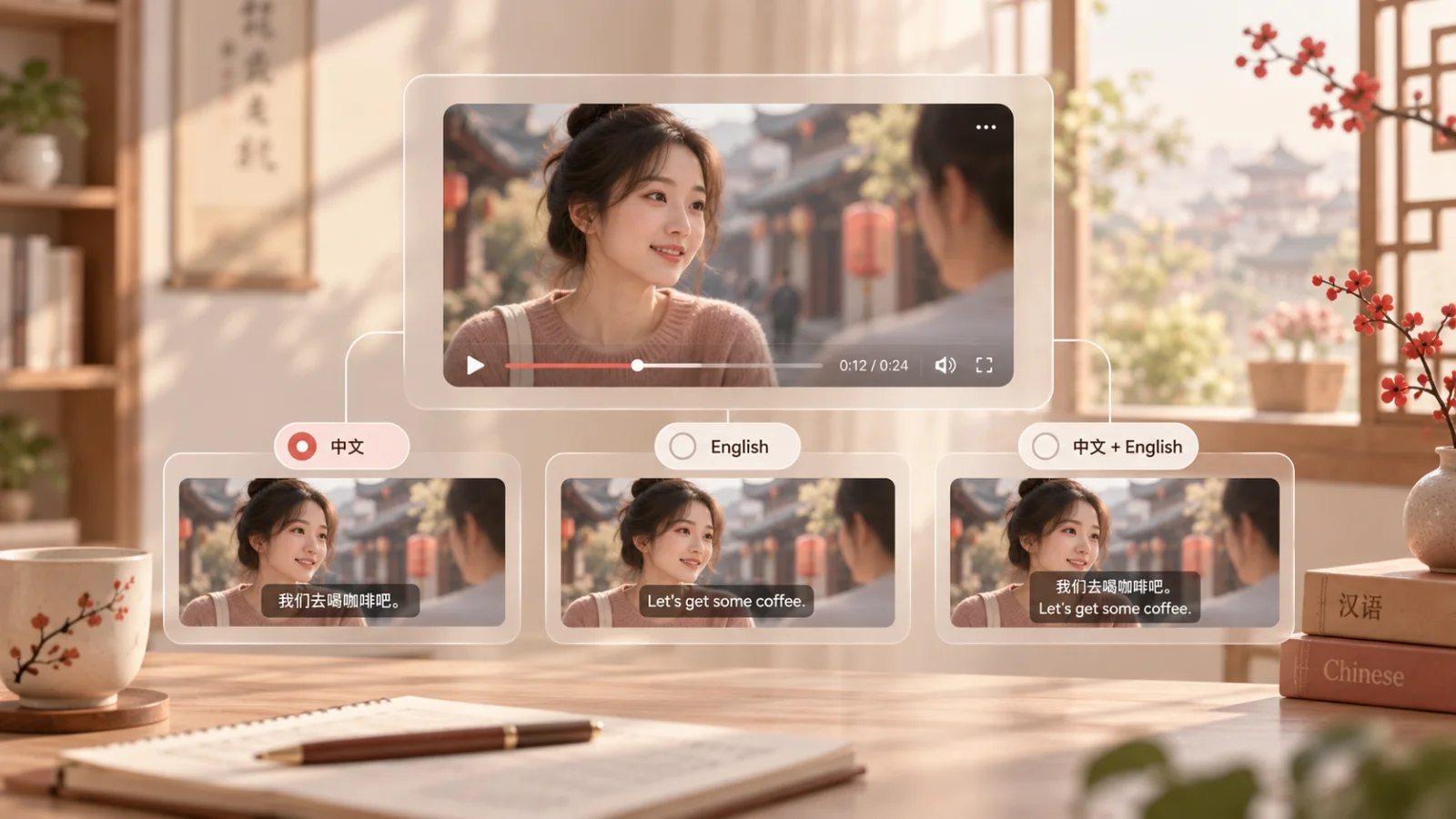
For a study session, start with Chinese subtitles if you can read enough to use them, and check English when the meaning is still unclear. Use both languages to examine a difficult line. Try a short passage without text when you want to check what you can hear unaided.
That is a set of starting options, not a rule that Chinese subtitles are always best. Understanding a scene, learning a phrase, and testing your listening are different tasks. Research comparing subtitle types has found different results for understanding content and learning the form of new words.
This guide assumes the soundtrack is Mandarin and English is a language you read comfortably. If another language gives you easier access to the meaning, use that translation instead. There is no requirement to learn Mandarin through English.
Choose a setting for the problem you have today
Use this table as a starting point, then adjust it after a short passage. These are study suggestions, not proficiency cutoffs.
| What happens when you watch | Try first | Give yourself this task |
|---|---|---|
| I understand almost nothing. | English or both languages for one short scene. | Establish what is happening, then check one Chinese phrase. |
| I understand the situation but miss details. | Chinese subtitles, with English available when needed. | Find the words that carry one missing detail. |
| I read the Chinese before I hear it. | A short text-free pass, then Chinese for checking. | Write what you actually heard before looking. |
| I want to test my listening. | A new short passage without text. | Answer a question before seeing any transcript or translation. |
| I am watching to relax. | Whichever subtitles let me enjoy it. | Follow the story without turning the whole episode into an exercise. |
You can use different settings in the same evening. Watching a drama for pleasure does not need the same setup as checking whether you recognize a particular sentence.
If you understand almost nothing, establish the meaning first
Choose a short scene and use English to find out who is speaking and what they are trying to do. Then select one Chinese line to work with. You do not need to decode an entire episode before returning to the audio.
If both languages are visible, pause and compare one phrase. Then hide or cover the English for a replay. If the Chinese line is also completely unfamiliar, keep the support and choose a simpler clip for focused study.
Do not select Chinese-only subtitles just because you have been studying for a certain number of months. In an eye-tracking study that included English-speaking learners of Chinese, how learners used captions varied with factors including the language and familiarity of the content. Character reading is part of the task, not a skill that every beginner already has.
If you understand the gist, use Chinese subtitles to check a detail
Keep the Mandarin soundtrack and try Chinese subtitles for the next short passage. Before replaying, decide what you missed: a time, a place, a reason, or whether someone accepted an offer.
Read the relevant line. If you can now explain it, leave the English closed. If not, check the translation or look up the phrase that is blocking the meaning. Then replay that part and listen for the information you found.
For this session, work on one detail rather than pausing at every unfamiliar word. At the end, note whether you caught that detail in the audio or only learned it from the text. Both are useful observations, but they tell you different things about what to practice next.
If you are reading ahead, change the order
Suppose the scene makes sense with Mandarin subtitles, but you lose it as soon as they disappear. Try this on one or two sentences: listen with the text hidden, jot down the meaning you caught, then open the Chinese and compare. Replay the same sentences once more with the text hidden.
The important change is recording your first answer before reading. You can then see what the transcript supplied rather than assuming you heard everything you understood. Hacking Chinese recommends listening before consulting the text when the immediate goal is listening comprehension.
Do not keep replaying a sentence you cannot understand even in writing. Check the unfamiliar language first. A text-free attempt is a useful check, not a requirement to stay confused.
Are two subtitle languages better than one?
Use both when you need to compare wording with meaning. Pause, identify the Chinese phrase, and check its English translation. For the next playback, try following the Chinese line rather than keeping your attention on the translation.
In a 2022 eye-tracking study of 112 Chinese learners of English, bilingual subtitles supported some measures of word-meaning learning, while same-language captions were better for recognizing word forms. Viewers using both languages spent more time on the Chinese translations than on the English target words.
That does not make bilingual viewing inherently passive. A 2026 study of 65 Chinese university English majors found that attention shifted toward the language being learned over repeated viewings.
Both studies concerned people learning English, not English speakers learning Mandarin. They support being deliberate about where you look; they do not establish one universally best subtitle setting for Mandarin learners.
If your eyes keep returning to English, make translation a check you open when needed. If comparing both lines helps you resolve a phrase, keep doing that. You do not have to commit to the same layout for every pass.
Try four kinds of support on one passage
Use My Mum and My Boyfriend by Lazy Chinese. Work with the early correction about where the speaker lives, after the self-introduction and before the story moves to her boyfriend. The creator’s transcript supplies the short extract below.
You do not need a player that displays two languages at once. Use the text here beside the video and show only the support you want. These are study displays for this page, not a claim that the upload offers all four settings.
Open the study extract
Before revealing the text: What claim about the speaker’s location gets corrected?
Text is hidden. Listen once and record what you hear.
These controls change the text on this page. They do not switch or synchronize YouTube caption tracks.
English only: establish the correction
Show the translation and replay the passage. Your task is to explain what was corrected, not to identify every syllable. Then close the English. Can you point to the moment when the speaker rejects the first location? Knowing the answer gives you a target to listen for. Do not count it as an independent listening result after you have read it.
Chinese only: locate the words that carry the meaning
Show the Chinese lines and replay the same part. Follow the phrase about living somewhere and notice where the negative appears. Keep the pinyin hidden unless character reading is blocking this step. Turn it on to check pronunciation, then return to the line and audio.
Both languages: compare, then look back at Chinese
Show both versions while paused. Identify which part of the Chinese corresponds to “don’t live.” Then replay while following the Chinese, using English only if you lose the meaning. This gives bilingual text a specific job: resolving a phrase.
No text: check what you can now pick out
Close the extract, including pinyin. Replay and try to identify the negative and the expression about residence in the sound itself. If you can explain the scene but cannot locate those words, mark that honestly: you know the content, but that phrase still needs listening work.
What should you use for your next video?
Choose one goal before you start. For following a story, keep the translation that lets you enjoy it. For studying a phrase, use Chinese text and open English where it resolves a genuine gap. For an independent listening check, use a new passage and record an answer before reading.
Try listen, check the necessary text, then listen again. On a difficult day, preview the meaning first and treat the next pass as supported practice. You do not need to turn every viewing session into a test.
If the question is where to find the track rather than which one to study with, read our guide to finding Chinese subtitles on YouTube. For a session that includes preparing vocabulary before viewing, use the 15-minute YouTube study routine.
You can follow the exercise with a browser and a note. For a guided prepare-watch-review workflow, try Learn Then Watch. Keep the text when it helps with the task. Put it aside when you want to check the sound. The setting can change from one passage to the next.