
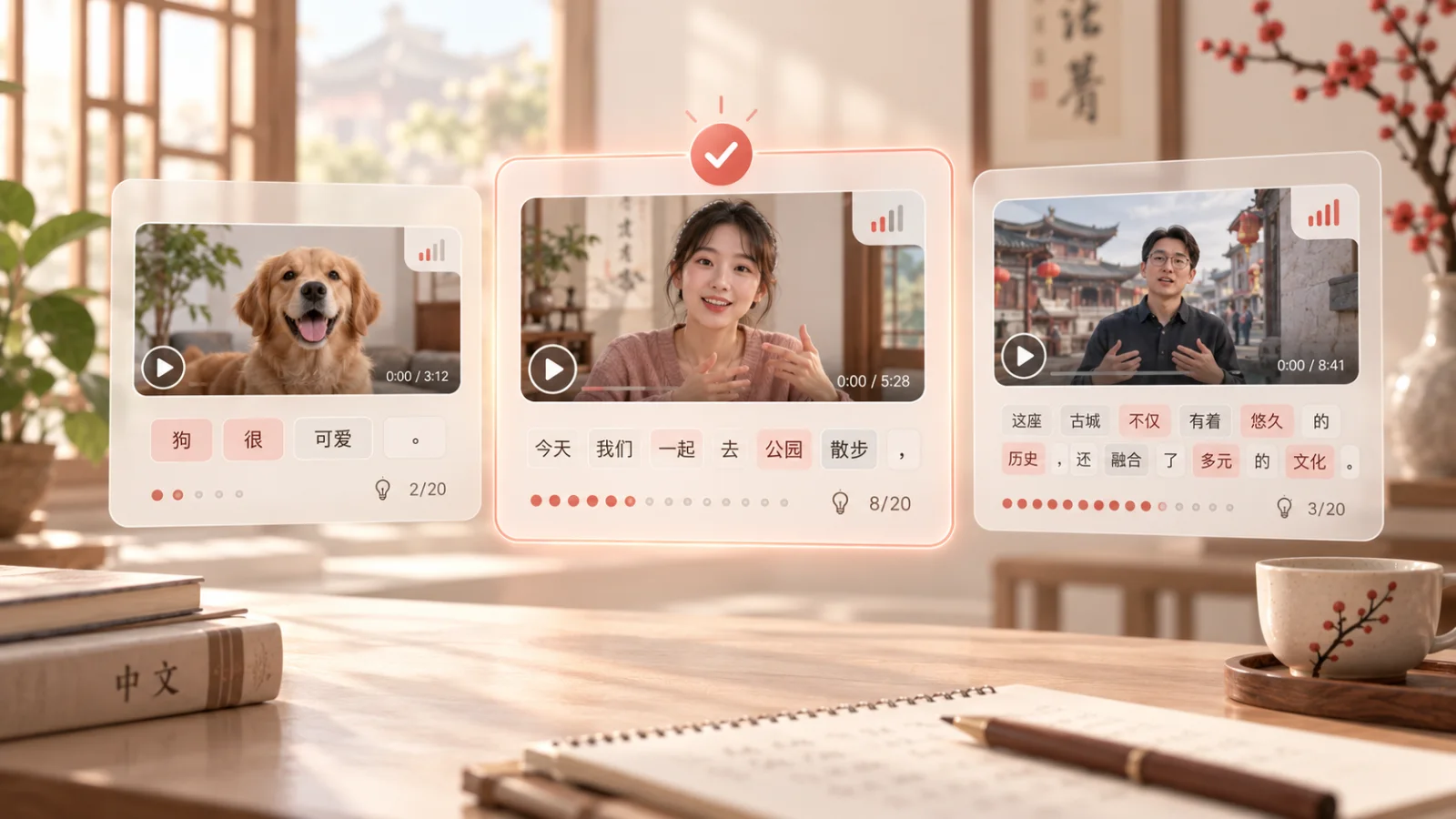
Use that difference to choose today’s material. For a regular listening session, aim for a passage you can follow, with a few gaps worth checking. Save a video that requires line-by-line decoding for a separate, more intensive lesson.
This guide gives you a short selection check, three worked examples, and a way to handle the frustrating middle ground: the story makes sense, but your vocabulary list keeps growing.
What is Chinese comprehensible input?
Comprehensible input is language whose message you can understand. For video, that understanding can come from familiar Mandarin together with the picture, gestures, repetition, and context. It does not require knowing every word in isolation. Hacking Chinese explains the principle and the different approaches built around it.
For this guide, the practical question is whether you can connect some of the Chinese you hear to what it means. Seeing someone carry a suitcase tells you about the scene. Recognizing where they are going or why they are leaving tells you more about your understanding of the language.
You do not have to choose between watching meaningful content and checking vocabulary. Here, we use a small amount of preparation when it helps you return to the video, rather than turn the entire session into dictionary work.
Try a short check before committing to the video
Choose roughly a minute from the main content, not just the greeting or channel introduction. Finish the thought if it runs a little longer. This is a practical sampling routine, not a standardized level test.
First, watch for a message
Use the picture and Chinese captions if they are useful to you. Keep English translation closed for the first attempt when possible. If you need translation from the start, use it, but note that your first understanding came with that support.
After watching, write one sentence about what was said and one specific detail: a choice, a reason, a place, or something that changed. English is fine. You are checking understanding, not testing your ability to produce a polished Chinese summary.
Ask yourself where the detail came from. Did you hear it, read it, or infer it from the image? None of those makes the viewing worthless. They show you what kind of task the clip currently offers. Text-supported understanding and listening without text should not be treated as the same result. See the discussion of listening goals and transcript use at Hacking Chinese.
Then, check the gap and replay
Open the Chinese transcript or pause the captions at a part you missed. Check one or two phrases, then replay that short part. Try to locate the newly understood phrase in the sound, rather than simply remembering the translation.
If that small repair lets you follow the next part, keep the video. If each line creates another pile of questions, shorten the passage or choose something easier for today.
For a final check, sample another part of the same video. A familiar introduction does not tell you how manageable the main explanation will be.
Three examples: too easy, workable, and too difficult
Imagine a learner who can follow basic introductions, knows common numbers and activities, and can read short Chinese sentences. Their goal today is a short listening session with a little new language.
The videos below are real. The learner’s reactions are illustrative situations, not measured results or universal difficulty ratings. A different learner could make a different choice.
Example 1: too easy for today’s vocabulary goal
Video: My Mum and My Boyfriend, Lazy Chinese. Use the opening self-introduction, before the story moves to the boyfriend. The creator’s transcript contains repeated corrections about the speaker’s name, nationality, and residence.
Suppose our learner follows all those corrections without the text and has nothing they want to look up. They can explain the information, not just recognize the names of countries. For their vocabulary goal, there is no reason to manufacture a list of new words. They can use this passage as a brief warm-up and move on.
But easy does not mean useless. Research-informed listening guidance includes using easy, familiar material to practice processing language with greater speed and ease. Keeping a comfortable video for relaxed listening is a legitimate choice, not a failure to challenge yourself.
Example 2: workable with a small amount of preparation
Video: Calendar Talk in Chinese, Lazy Chinese. The creator lists it as a beginner video about days, dates, and activities. For this sample, ask yourself to connect one activity to the day or date being discussed. Catching a number by itself is not the complete task.
Suppose our learner follows the time references but misses an activity phrase. After checking that phrase, they can replay the passage and connect the event with its time. The rest remains manageable without translating every line.
That is a useful candidate for today’s session. The learner has a specific gap, a way to resolve it, and enough familiar language to keep following the speaker.
Example 3: too difficult for regular listening today
Video: Are Flashcards Effective?, Lazy Chinese with Xiaogua Chinese. The creator labels this discussion advanced. The transcript contains contrasting opinions and reasons about flashcard use, rather than just naming objects or describing a routine.
Suppose our learner knows the topic from the title but cannot explain a speaker’s reason without translating several sentences. Looking up the word for flashcards does not solve the problem: too much of the argument is still unfamiliar.
That makes it a poor choice for this learner’s regular listening session today. They could save one exchange for a teacher-supported lesson or return to the discussion later. They do not need to prepare the vocabulary of the entire conversation just to justify watching it now.
What if the story is clear, but there are many unfamiliar words?
Do not immediately turn every unknown word into a flashcard. First check whether you understand some of the Mandarin, or whether the images and English subtitles are doing nearly all the work.
If you can follow the spoken message with occasional gaps, separate the unfamiliar language by what it does in the passage.
| What the unfamiliar item does | What to do for this session |
|---|---|
| It changes the main meaning or blocks the next sentence. | Check it before continuing. Keep the phrase in context. |
| It keeps returning and would be useful to you. | Consider saving it, but do not interrupt every occurrence. |
| It adds a minor detail you can follow without. | Leave it for now, or put it in a reference note rather than a review deck. |
A place name or ingredient can belong in any row. Its role in this particular passage matters more than the category of word.
Here is an original practice sentence, not a quotation from the linked videos:
Recognizing 面馆, miànguǎn, “noodle shop,” gives you the setting. To understand why the plan does not work, you also need the contrast in 可是, kěshì, “but,” and 不开门, bù kāimén, “not open” in this context. Knowing the shop’s name would not replace that information.
For a short session, try preparing up to three expressions that block the main point, then watch the passage again. Three is a planning limit for this routine, not a scientific definition of suitable input. You can choose a different limit.
If the list keeps expanding before you can understand even one exchange, reduce the passage or change videos. If you already know the expressions in writing, spend that preparation time on their sound instead of adding duplicate vocabulary cards.
Do you need to know 95% or 98% of the words?
There is no need to calculate a percentage before every video.
Lexical coverage means the proportion of word occurrences in a passage that fall within a learner’s known vocabulary. It is not the percentage of the story understood, and it is not a count of recognized Chinese characters.
A study using short English documentary clips found that comprehension generally decreased when more words were replaced with unfamiliar nonwords. The authors investigated particular coverage levels under controlled conditions. Those findings do not establish one automatic cutoff for an individual watching a Mandarin vlog. Read the study in Studies in Second Language Acquisition.
For your own choice, use the sample you just watched: Can you connect the main events or ideas? Can you catch a detail? Does checking a small amount of language let you continue? Those observations are more useful for this decision than an unmeasured claim that you understand “about 90%.”
Change the support before rejecting a promising video
The words are familiar, but the delivery loses you. Try shorter sections and replay them after checking the text. A modest slowdown can be a temporary aid. Keep a note of that setting rather than treating slowed, supported viewing as an independent listening test.
The Chinese captions help, but you only understand while reading. Keep the video for supported practice. After checking one line, try listening to that line with the text hidden if that is accessible to you. For longer listening without text, choose an easier recording. You do not have to remove captions needed for access.
The video stays interesting, but the vocabulary is too dense. Save it for enjoyment with translation or for a focused lesson. Choose a more manageable clip for today’s listening practice. It can serve one purpose without serving every purpose.
One part is manageable and another is not. Keep the part that works. Selecting a video does not commit you to studying its entire running time.
For a fuller comparison of text support, see Chinese or English subtitles for learning Mandarin. This guide’s job is to help you choose the material, not prescribe one subtitle setting for everything.
Your video-selection checklist
Before you save the video for regular practice, check these five points:
- I can explain something the speaker said, not just describe the picture.
- I can identify a detail and say whether I heard it or used text to find it.
- I can follow a short stretch without translating every sentence.
- The gaps are manageable with the support and preparation time I have today.
- I am interested enough to continue watching.
If the first four are mostly missing, try a shorter passage or easier material. If they are all comfortable, keep watching; unfamiliar vocabulary is not an admission requirement. This checklist is a way to choose a study activity, not a score for your Mandarin level.
Need a starting selection? Use our short Chinese videos for beginners. Once you have chosen a passage, follow the 15-minute YouTube study routine to prepare, watch, and review it.
You can make this choice with a browser and a note. For a guided prepare-watch-review workflow, try Learn Then Watch with a supported video.
Choose the clip you can make sense of today. A more difficult one can stay on your watch-later list until it serves the session you want to have.