
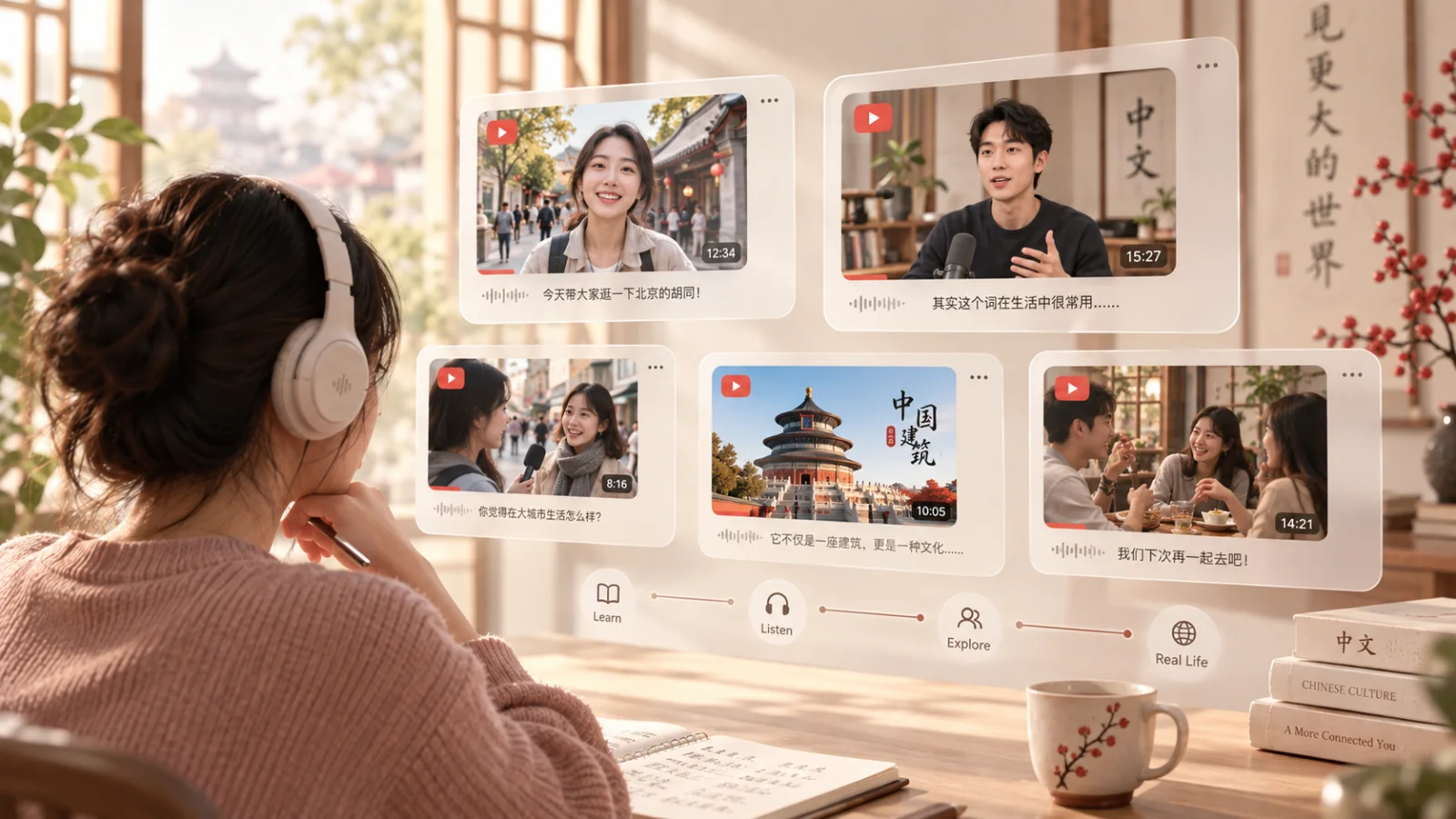
Try changing one part of the task. Keep a familiar topic but listen for longer. Keep the topic and try a different speaker. Then try following a reply that you could not predict from the question.
The five Chinese learning YouTube channels below offer specific places to start: an apartment tour, an everyday podcast episode, a cultural explanation, street interviews, and a discussion between two teachers. Some selections are still made for learners. That is intentional: you can work on longer speech before giving up familiar topics and text support.
This is not a ranking from best to worst. Choose the kind of listening you need next. The level notes are starting suggestions, not official HSK equivalents.
Pick your next listening task
| Try this when... | Channel | A specific starting point |
|---|---|---|
| You want everyday language with a visible setting. | Mandarin Corner | My Apartment in China |
| You can follow a short story but want more than basic routines. | Cozy Mandarin | Episode 158: Waiting in Line |
| You want to follow a longer explanation about one subject. | TeaTime Chinese | Episode 86: Tea Culture of China |
| One familiar presenter is manageable, but new voices are harder. | Easy Mandarin | Learn Mandarin from the streets playlist |
| You can follow explanations and want a more demanding conversation. | Lazy Chinese | Are flashcards effective? with Xiaogua Chinese |
The specific sources and text support are linked below. The last selection is an optional stretch: its creator labels it Advanced.
1. Mandarin Corner: describe a real place before tackling an abstract discussion
Start with: My Apartment in China.
Mandarin Corner places this video in its Lower Intermediate collection. Eileen introduces her apartment in Chinese, making it a concrete alternative to another classroom-style vocabulary list. The creator’s description confirms Chinese-character and pinyin subtitles; the official catalog also lists versions with and without English.
The format gives you one person describing a setting. Use it before moving to an interview where you must follow different people and their replies. That does not mean every household word will be familiar. The task is to connect the description to the place, not to memorize every object.
Subtitles and text: choose the version whose support you need. A version marked “No English” is not necessarily text-free. The advertised Chinese and pinyin subtitles are not a guarantee of a separately selectable transcript, so inspect the actual player before planning an import.
Move on when the description is comfortable, not when you have made a flashcard for every item in the apartment.
2. Cozy Mandarin: follow an everyday situation beyond the first sentence
Start with: Episode 158, Waiting in Line 排队.
Clara presents Cozy Mandarin as clear, learner-focused listening. This episode is labeled Intermediate. It uses waiting in line to move from a familiar situation to complaints, reactions, and a story about someone cutting in. This is one-host narration, not a recording of several people arguing in a real queue.
Choose it when you can understand a description but lose track as soon as the speaker adds an opinion or explains what happened next. Stay with the thread of the story rather than stopping at each new expression.
Subtitles and text: the creator publishes a Chinese transcript on the episode page. It is useful for checking a missed line, but a webpage transcript is different from a switchable YouTube caption track.
Leave later sections for another session if following that one event already takes effort. You do not need to finish the episode to get a useful listening task from it.
3. TeaTime Chinese: stay with a longer explanation
Start with: Episode 86, 中国的茶文化 / Tea Culture of China.
TeaTime Chinese is explicitly aimed at intermediate learners and presents culture, history, literature, and society in accessible Chinese. The tea episode is a focused starting point for this format. Treat it as a cultural listening lesson, not a live conversation.
The challenge is holding onto an explanation across several sentences. You are not simply identifying an object or catching a short reply. Historical names and references may require a note, but you do not have to memorize them all to follow the main point.
Subtitles and text: the creator’s episode notes direct listeners to free transcripts. Use that text for support rather than assuming every YouTube upload has the same caption options. The catalog is also a fallback if the individual page redirects.
If you can list several names but cannot explain the section, return to a shorter passage. The point is to follow the explanation, not collect historical vocabulary.
4. Easy Mandarin: hear different answers to the same question
Start with: Easy Mandarin - Learn Mandarin from the streets.
Easy Mandarin interviews people in everyday settings. The creators describe their videos as street interviews with both Chinese and English subtitles. That makes this a different task from following a single presenter: you hear different respondents approach a question in their own way.
Choose an everyday topic from this playlist and work with two respondents, not the entire video. Establish the question first. Then give each person a separate line in your notes: their answer and, if they give one, their reason.
Subtitles and text: Chinese and English support is part of the format described by the creators. Check the individual upload before assuming the two languages can be switched off separately. Use English when a reply remains unclear, then return to the Chinese wording for that short answer.
Do not require every respondent to be equally easy. If one answer loses you, study that reply separately or try another. For the next session, change the topic or speaker rather than replaying only the answer you now know by heart.
5. Lazy Chinese: an optional stretch into disagreement
Start with: Are flashcards effective? with Xiaogua Chinese.
This selection needs a clear label: the creator calls it Advanced Chinese. Keep it for an upper-intermediate stretch, not as the first recommendation after beginner lessons.
Suqing from Lazy Chinese and Zhifei from Xiaogua Chinese discuss different views on flashcards. Their transcript includes agreement followed by qualification, follow-up questions, and responses to what the other person has just said. The topic is familiar to many learners, but following the exchange is more demanding than recognizing individual study-related words.
Subtitles and text: there is a public Chinese transcript on the creator’s page. Use it to untangle a short exchange when necessary; a separate Chinese CC track has not been confirmed for this recommendation.
Your task is to understand the speakers’ views, not decide which learning method wins. If you recognize the topic but cannot follow either reason without translating every line, save this video for a later session.
Choose a regular channel and one harder option
You do not need five new subscriptions or a week of browsing. Pick one starting point you can use regularly and one more demanding option to sample occasionally.
For example, work with the apartment tour first, then try two Easy Mandarin interview answers. Or use Cozy Mandarin for a manageable session and save a short Lazy Chinese exchange for a separate attempt. These are suggested combinations, not a fixed course or an order you must complete.
Before saving a video, sample a short passage and ask yourself what you understood from the speech. Catching a detail after checking the Chinese text is useful supported practice. Remembering only the English translation gives you a different task to work on next.
When a video is promising but unfamiliar vocabulary gets in the way, prepare a few expressions that carry the main point. Skip familiar words. Then watch the same passage again and check whether those expressions are easier to recognize.
For a fuller selection method, use our guide to choosing Chinese videos at the right level. Once you have a passage, the 15-minute YouTube study routine gives you a way to prepare, watch, and review it.
Keep text support separate from difficulty
Do not choose a channel only because its page says “with subtitles.” For these recommendations, text support takes different forms: subtitles supplied with a video, a transcript on the creator’s website, or a separate reading resource. The notes above specify which support was confirmed.
Choose the script and amount of help you can actually use. Needing Chinese text for a new speaker does not mean you must return to beginner material. It may mean this particular passage works as supported practice rather than a listening-only check.
Our guide to Chinese or English subtitles for learning Mandarin covers that choice. For the technical steps, use finding Chinese subtitles on YouTube.
There is no single best Chinese learning YouTube channel for every part of this transition. For your next session, choose one video and one task: describe a place, follow a story, explain a point, or compare two answers.
You can do that with the original video and a note. For a guided prepare-watch-review workflow, try Learn Then Watch with a supported video.
Start with the passage you can work with today. Keep the more difficult conversation for another session, not as a test you must pass before enjoying Chinese videos.