
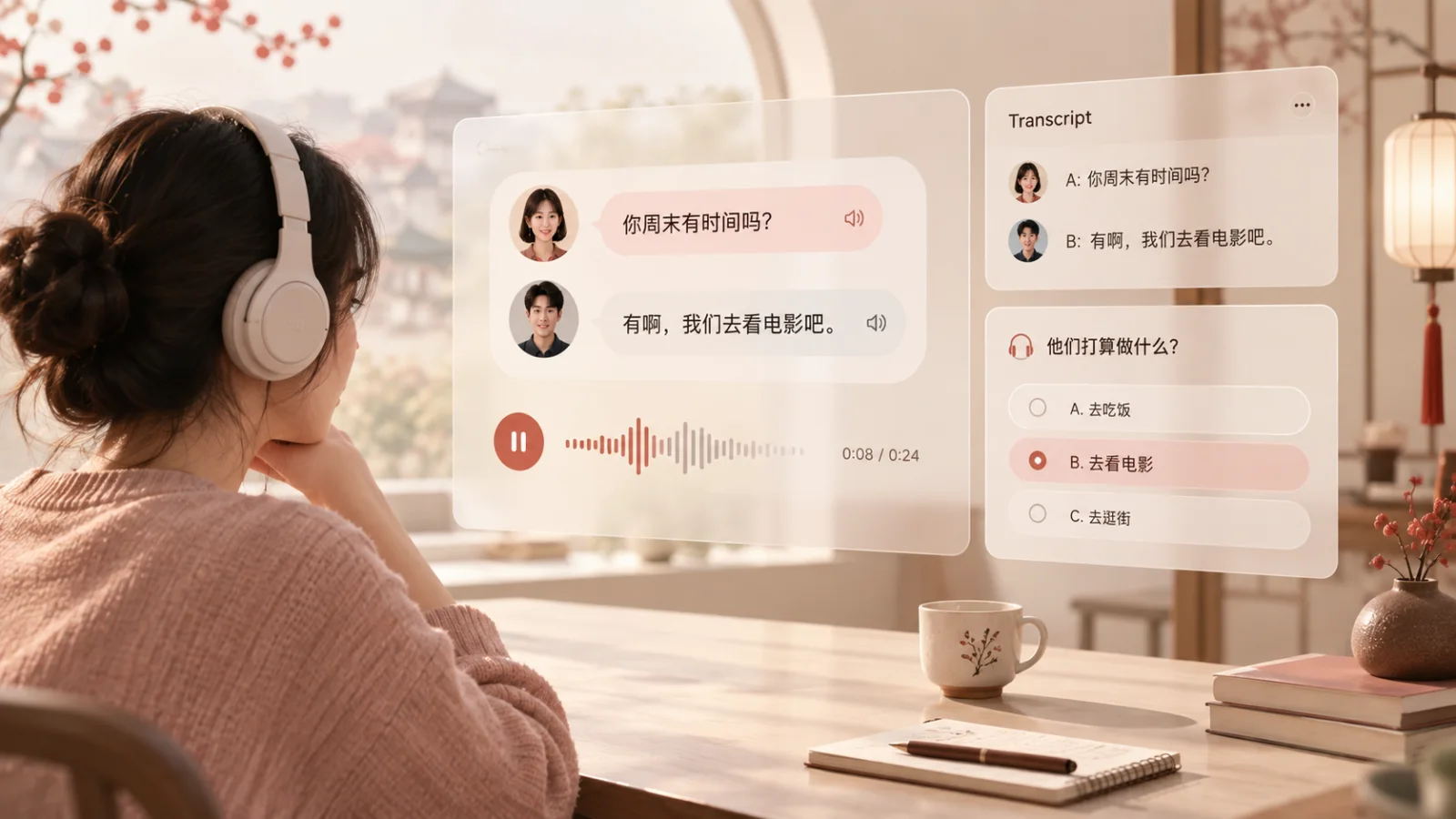
Each exercise includes a Mandarin recording, a Chinese transcript, pinyin, an English translation, a few words to check first, and three questions with answers. The conversations are fictional and written for this practice page. The prices and directions are part of the exercises, not real-world recommendations.
For easy Chinese listening practice, start with the first conversation. It assumes you know a few greetings and basic sentences. The last two add directions and a change of plan. You do not need to finish all five in one sitting.
How to use these Chinese listening exercises
Check the short vocabulary list and read the questions. Listen once with the transcript closed. Write a brief answer in English or Chinese, then listen again for the details you missed.
Open the transcript after that. Use pinyin for words you cannot read yet, and check the English when the meaning is still unclear. Finally, close the text and replay the conversation. Can you now hear the part that caused trouble?
If you are completely new to Mandarin, read along on the first pass. Treat it as guided practice rather than a test. You can try listening without the text on the next pass.
1. Meeting a classmate
Anna and Mark meet before a Chinese class. Listen for what they have in common and what they decide to do next.
Before you listen
student
to live
beside; next to
together
what a coincidence
Check what you heard
- What are Anna and Mark studying?
- Where does Anna live?
- When will they go to school together?
Show transcript
Hi, I’m Anna. What’s your name?
I’m Mark. Are you a student here too?
Yes, I’m studying Chinese. How about you?
I’m studying Chinese too. Where do you live?
I live next to the school.
What a coincidence! I live there too.
Then let’s go to school together tomorrow.
Sure. See you tomorrow!
Show answers
- Chinese. 我学中文。 / 我也学中文。
Both speakers say they study Chinese.
- Next to the school. 我住在学校旁边。
The location is next to the school.
- Tomorrow. 明天一起去学校
明天 is the time word to catch.
2. Ordering a coffee
A customer orders at a café. Listen for the choices they make, not just the word for the drink.
Before you listen
latte
hot
iced
to take away; to go
yuan, in everyday prices
Check what you heard
- Does the customer choose a hot or an iced drink?
- Will the customer drink it at the café?
- How much does the drink cost in this dialogue?
Show transcript
Hi. What would you like to drink?
I’d like a latte.
Hot or iced?
Hot. A small is fine.
Sure. For here or to go?
To go. How much is it?
Twenty yuan.
Great, thank you.
Show answers
- A hot drink. 热的,小杯就好。
The customer’s reply gives the answer.
- No. The order is to go. 带走。
The customer repeats the takeaway option.
- Twenty yuan. 二十块。
This is a fictional exercise price.
3. Buying water at a convenience store
A customer compares two bottles of water. Keep the price of one bottle separate from the final bill.
Before you listen
bottle; measure word
two before a measure word
in total
to pay
to scan
Check what you heard
- How much is the larger bottle?
- What does the customer buy?
- What is the final bill?
Show transcript
Hi. How much is this bottle of water?
Three yuan.
What about that one?
Five yuan. That bottle is a little bigger.
I’ll take two small ones.
Sure. Six yuan in total.
Can I pay with my phone?
Yes. Just scan here.
Show answers
- Five yuan. 五块。那瓶大一点。
Three yuan is the smaller bottle.
- Two small bottles. 我要两瓶小的。
两 gives the quantity; 小的 gives the size.
- Six yuan. 一共六块。
Listen for 一共 before the total.
4. Finding the subway station
Listen for the turn, the landmark, and the walking time. You can sketch the route.
Before you listen
subway station
intersection
turn right
bank
approximately
Check what you heard
- Which way should the person turn?
- What is next to the subway station?
- About how long is the walk?
Show transcript
Excuse me. Where is the subway station?
Go straight ahead and turn right at the intersection.
And after I turn right?
The subway station is right next to the bank.
How long does it take to walk there?
About five minutes. It’s not far.
Okay, thank you!
You’re welcome.
Show answers
- Right. 到路口右转
Catch 右, not 左.
- A bank. 在银行旁边
银行 is the landmark.
- Five minutes. 五分钟左右
左右 makes the time approximate.
5. Making plans for the weekend
Two friends arrange a trip to the movies. The first suggested time does not stick.
Before you listen
Saturday
movie
finish class
meet; see
entrance
Check what you heard
- What time do they finally agree to meet?
- Why does 2 p.m. not work?
- Where will they meet?
Show transcript
Do you want to go to the movies together on Saturday?
Sure! What time?
How about two in the afternoon?
Two doesn’t work. My class doesn’t finish until three.
What about four, then?
That works. Where shall we meet?
Let’s meet at the movie theater entrance.
Okay. See you at four on Saturday.
Show answers
- 4 p.m. on Saturday. 周六四点见
Two is rejected; four is accepted.
- Class finishes at 3 p.m. 我三点才下课。
Three is the end of class, not the meeting time.
- At the movie theater entrance. 在电影院门口吧。
They agree on the entrance.
Finish one small listening task
You do not need perfect comprehension. Choose one dialogue, answer its three questions, then replay the lines that changed your answer. Return another day and listen once before opening the transcript.