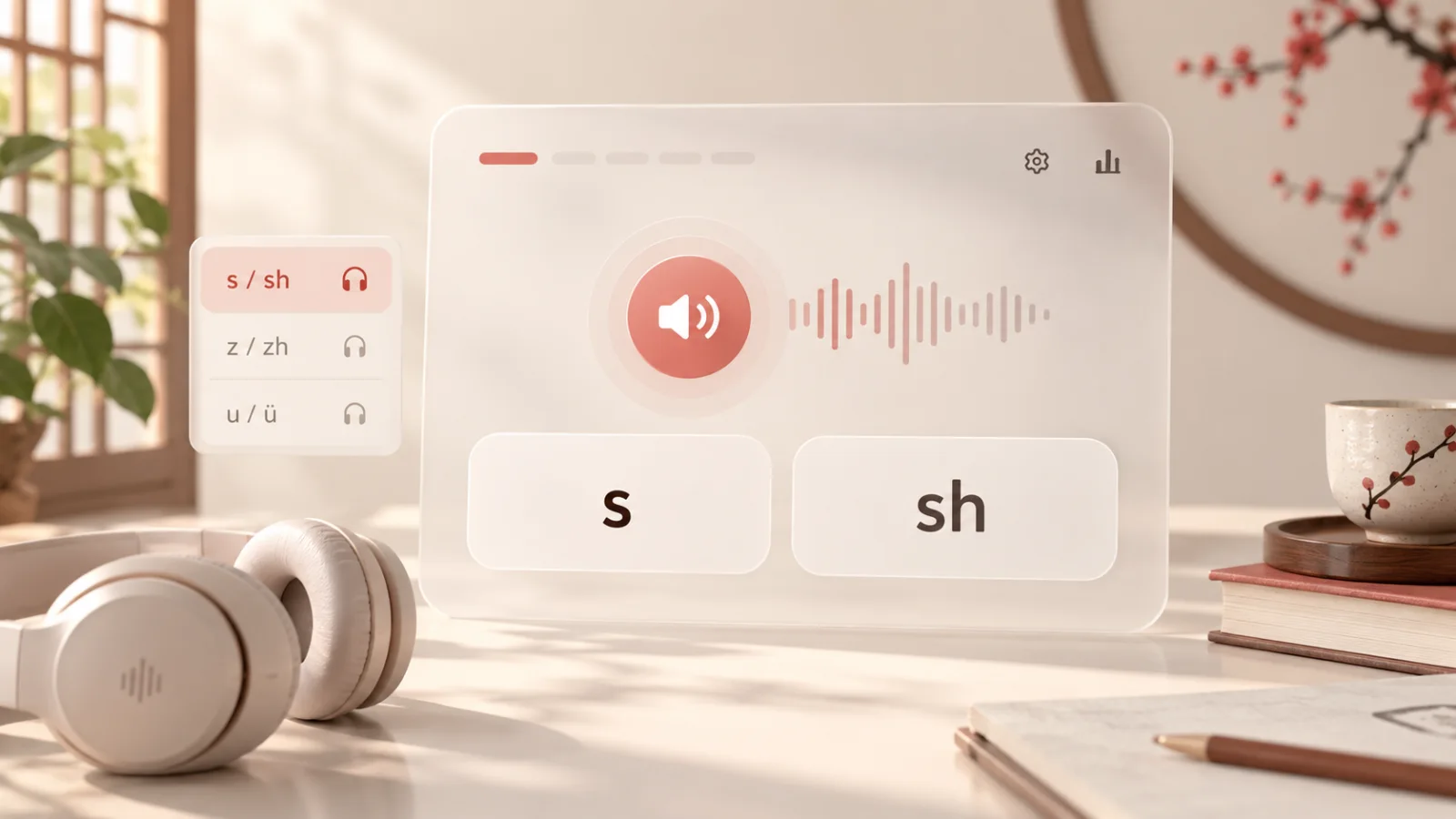
Pinyin Listening Practice: 10 Audio Exercises for Confusing Mandarin Sounds
Can you hear the difference between sān and shān without seeing the characters? What about lù and lǜ?
This pinyin listening practice gives you ten short recordings and two choices for each one. Listen, choose the syllable you hear, then open the answer. The characters and meanings appear afterward, so knowing the vocabulary is not a requirement.
Both choices in each exercise have the same tone. That is deliberate: the task is to distinguish a consonant or vowel, not to choose the option with a different pitch pattern.
This set is for learners who have already met the basics of pinyin. Work through the explanations one group at a time. There is no time limit and no need to finish all ten at once.
Before you press play
Use a comfortable volume and start at normal speed. Listen once, replay if needed, and choose A or B before opening the answer. Make a small note when you guessed, even if the guess was right.
After checking, replay the recording and say the syllable back. The exercise checks your listening choice; it does not assess the accuracy of your own pronunciation.
Exercises 1–2: s or sh?
For standard Mandarin, s is made with the tongue farther forward, near the teeth. For sh, the tongue tip is raised farther back. Use the position as a pronunciation cue, then return to the recording rather than trying to solve the sound from the letters alone.
Exercise 1
s or sh?
Which syllable do you hear?
Show answer
Answer: B. shān
山mountain
Both choices end in ān. The difference to notice is the beginning: sh rather than s. Replay the syllable once before moving on.
The position contrast returns here: z is farther forward, while zh is made with the tongue tip farther back. Listen to the opening of the Mandarin syllable rather than mapping it to an English letter sound.
Exercise 3
z or zh?
Which syllable do you hear?
Show answer
Answer: B. zhǎo
找to look for
The target begins with zh. Focus on the short opening of the syllable, then listen to the whole recording again. Do not choose zǎo just because it is a word you already know.
Keep your attention on the initial. Both options end in ū and have the first tone. This item checks the same contrast as exercise 3 with a different final.
The c/ch pair also contrasts a forward tongue position with one farther back. Keep the complete syllable in your ear. You are choosing between two Mandarin initials, not deciding whether the recording contains an extra spoken “h.”
Exercise 5
c or ch?
Which syllable do you hear?
Show answer
Answer: B. cā
擦to wipe
The answer starts with c, not ch. The h in the other spelling is part of a different initial; it is not an instruction to pronounce a second syllable.
For b/p and d/t, listen for the puff of air after the consonant release. Mandarin p and t have a stronger puff than b and d. The distinction is not simply quiet versus loud, so leave the player volume alone.
Exercise 7
b or p?
Which syllable do you hear?
Show answer
Answer: A. bā
八eight
In standard Mandarin, b has little or no following puff of air compared with p. Listen near the release of the initial, rather than judging which option would sound louder.
The target starts with d, the unaspirated member of the pair. Both options use the second tone. This is a consonant question, not a choice between two pitch patterns.
The two dots matter. u and ü are different vowels, and both use rounded lips. For ü, hold your tongue as if saying “ee,” then round your lips without pulling the tongue back. Treat the English comparison as an approximation and use the recording as your reference.
Exercise 9
u or ü?
Which syllable do you hear?
Show answer
Answer: B. lù
路road
The initial l stays the same. Listen to the vowel: u, not ü. Both choices have a falling fourth tone; the two dots change the vowel, not the tone.
If s/sh, z/zh, or c/ch was difficult, choose one pair for your next practice and ask a teacher to alternate two new syllables while you listen without seeing the notes.
If b/p or d/t was difficult, return to the release of the initial and listen for aspiration. Simply turning the volume up is not the exercise.
If u/ü was difficult, practice the vowel position briefly, then try another recording. Keep the tongue forward while rounding the lips for ü.
Do not treat ten correct answers as proof that you will recognize every speaker in fast conversation. For your next check, use new recordings and a different speaker rather than memorizing this page’s answer order.
For today, choose one contrast to revisit. Write down the pair, not just “practise pronunciation.” Next time, you will know exactly what to listen for.
Audio credits and pronunciation references
Recordings are credited to Wei Gao and Vion Nicolas / The Shtooka Project, via Wikimedia Commons, under Creative Commons Attribution 2.0 France. Individual source pages are linked inside every exercise answer.