
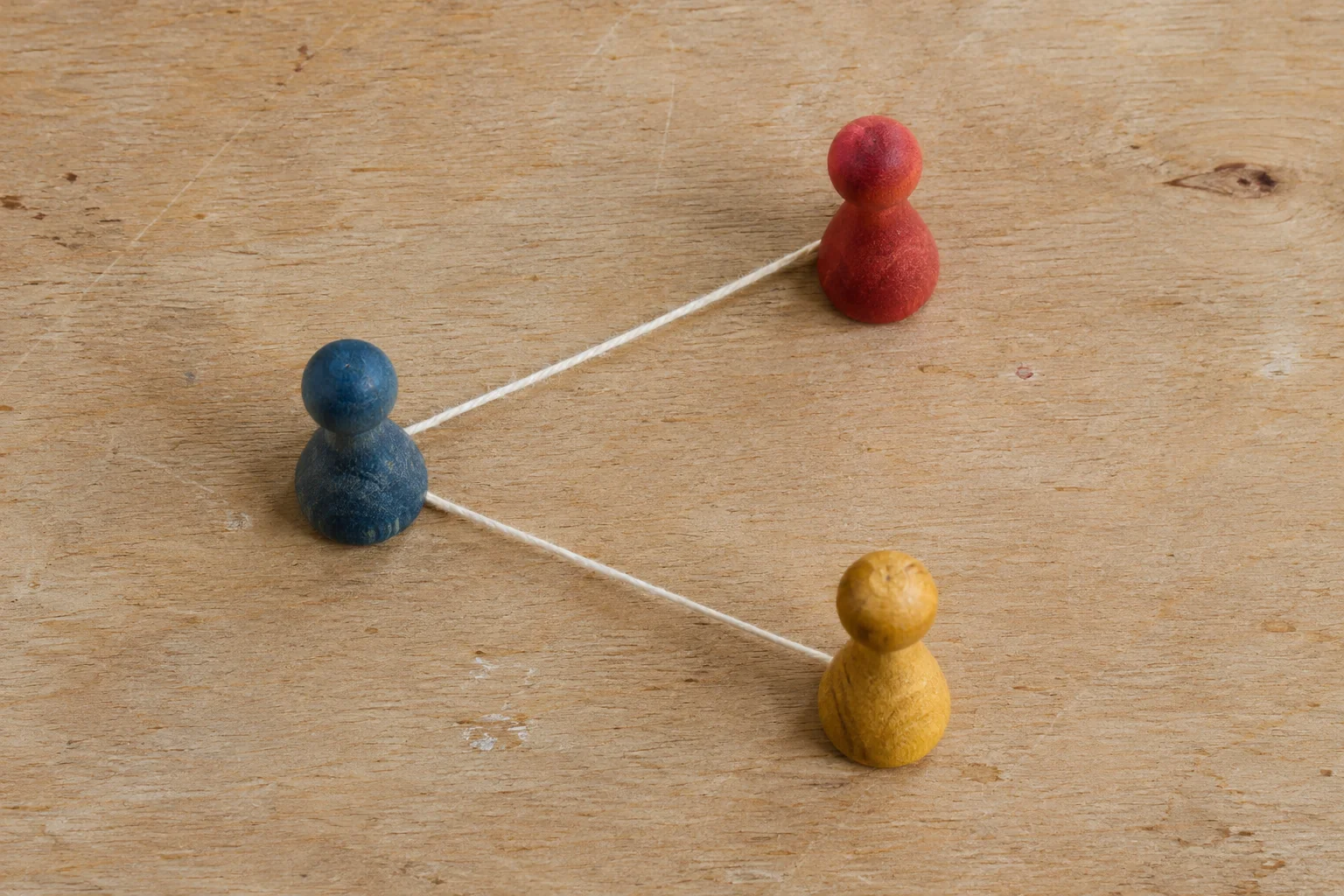
A story introduces a creator, a friend, and a teacher. A few sentences later, you know someone forgot a book but cannot say who. Looking up the word for “book” will not solve that problem. The difficulty is reference: keeping the right person attached to the action. Start with a short story containing two or three people. Your first task is a clear account of the scene, not a transcript of every line.
Give each person a place on the page
Write each name or role in a small box when it appears. Add an action beneath the box only when the passage supports that connection. If the speaker says “my friend,” keep that role label rather than inventing a name. If you lose track, leave a question mark beside the action. This is a more useful record than silently assigning the action to the person mentioned most recently and treating the guess as confirmed information.
In this invented context, the natural reading is that Xiao Li will return the book. Draw the book moving from Xiao Wang to Xiao Li, then an arrow for the planned return. The map supplies a reason for the interpretation. Do not turn this example into a rule that a pronoun always refers to the nearest name. A different surrounding story or an explicit clarification could change what a short reference means.
Track objects as well as people
| Item to track | Useful note | Question when it becomes unclear |
|---|---|---|
| Person | Name or role plus action. | Who is responsible for this action? |
| Object | What changed hands or location. | Which item does “this” point to? |
| Place | Where the current event happens. | Does “there” refer to the earlier location? |
| Reported view | Whose statement is being repeated. | Is the speaker quoting or endorsing it? |
In a video, pointing, camera changes, and visible objects can help. Use them as evidence, then check the spoken line. If the creator points at one bag while mentioning another, slow down and inspect that moment. A subtitle alone may not show the visual reference. Conversely, a picture can suggest a plausible story that the speaker never stated. Your job is to combine the available clues without replacing uncertain words with an attractive guess.
For location references in a route, use Chinese directions listening. A place can be a starting point, a landmark, or a destination; the same short reference should not merge those jobs.
Repair the smallest unclear stretch
When your map becomes inconsistent, go back to the last clear name or object. Replay from there through the confusing action. Ask whether a new person entered, an object moved, or the speaker began reporting someone else’s words. Do not start the whole video again unless the setup itself is missing. A local replay gives you a specific question and makes it easier to tell whether the transcript actually resolves the uncertainty.
The Chinese interview-listening guide adds a question-and-answer map. Combine the two when a guest tells a story about another person’s opinion.
A story map that changes when the book changes hands
Extend the book scene. Xiao Wang gives the book to Xiao Li. Xiao Li later lends it to a classmate. At the end, someone says the classmate will return it tomorrow. Draw the object’s path before retelling the plan. If you leave the book under Xiao Li’s name because that was the earlier clear reference, you may assign the last action to the wrong person.
| Moment in the invented story | Person holding the book | Action to record |
|---|---|---|
| Before the first transfer. | Xiao Wang. | Gives it to Xiao Li. |
| After the first transfer. | Xiao Li. | Lends it to a classmate. |
| At the stated final moment. | The classmate. | Is expected to return it tomorrow. |
Quoted words need their own speaker label
Imagine the narrator says a teacher thought the book was difficult, while the student found it enjoyable. The narrator has reported two views, not necessarily endorsed either. Make two small opinion boxes beside the names. When the next line says “that surprised me,” identify what “that” points back to: the teacher’s judgment, the student’s reaction, or the contrast between them. The whole preceding event may be the reference. Looking for the nearest concrete noun alone can miss the connection.
Repair these three reference notes
- Note: “He gave it to him, then he said he would return it.” Repair by using the names or roles that the source establishes. If one remains uncertain, mark that one explicitly.
- Note: “The narrator dislikes the book.” Source: the narrator reports that a teacher called it difficult. Repair the attribution; difficulty is the teacher’s reported judgment, not automatically the narrator’s view.
- Note: “That means the book.” Source: “That surprised me” follows a contrast between two reactions. Check whether the reference is the whole situation rather than a single object.
For a practical microtask, take a short familiar passage and replace the pronouns in your written summary with names, roles, or clear objects. Circle each replacement you cannot justify. Now replay from the last justified reference through the uncertain one. This gives you a small set of questions instead of a demand to understand every word again. If the replay resolves only one circle, keep the others. Partial repair still shows precisely what became clearer.
For a final check, retell the book scene using names: “Xiao Wang gave Xiao Li the book; Xiao Li lent it to a classmate; the classmate will return it tomorrow.” Compare each action with the source. For a new story, circle any name you cannot justify, then replay from the last clear reference.
Find connected tasks in the Chinese learning hub. Today, finish with two people and one action linked correctly before adding a more complicated story.
Use LearnThenWatch for Chinese to prepare unfamiliar expressions, watch the scene, and review the useful language afterward. Keep your person-and-action note beside any expression whose meaning depends on who was speaking.